
Grown in Weeks: How a Laboratory-Grown Diamond Is Made
Maanorah Team
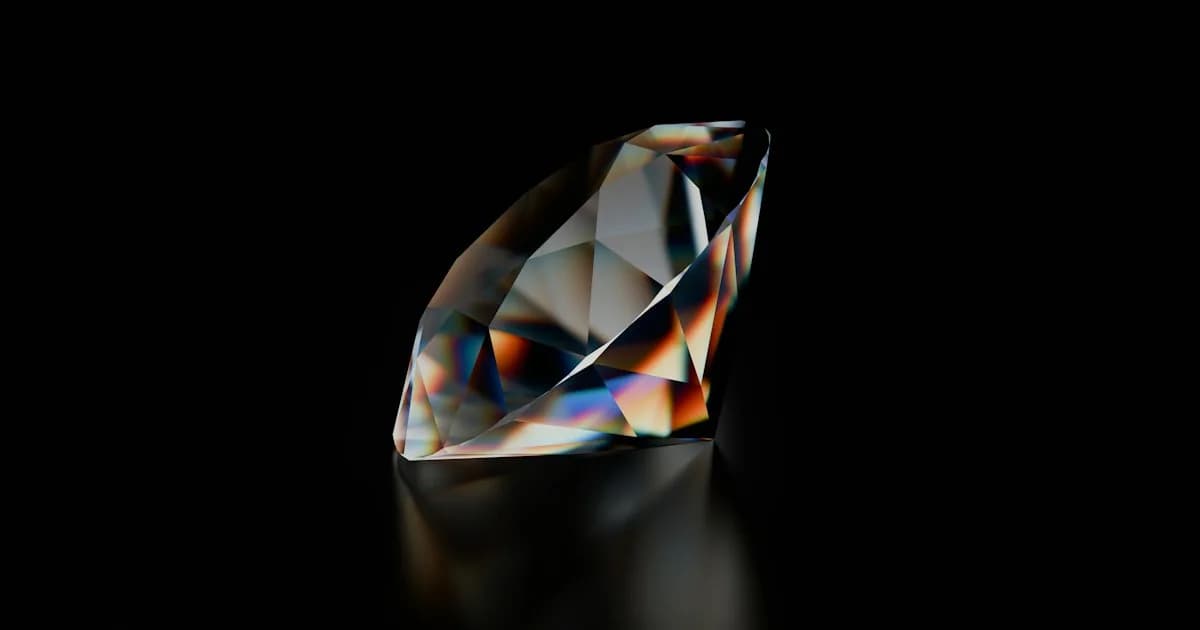
Deep underground, a diamond takes an unimaginably long time to form. In a laboratory, the same crystal grows in a few weeks. It is one of the most remarkable things people have learned to do, and the result is just as remarkable: a diamond, carbon atom for carbon atom.
Here is how it happens, and what it means for the diamond you wear.
What exactly is a laboratory-grown diamond?
It is diamond: pure carbon in the same crystal structure as a mined diamond. It has the same hardness (10 on the Mohs scale), the same brilliance and the same fire. Chemically, physically and optically, the two are the same. The only difference is where the crystal formed.
There are two ways to grow one: chemical vapour deposition (CVD) and high pressure, high temperature (HPHT).
How does CVD work?
A diamond is built up, layer by layer, from a carbon-rich gas.
- A thin slice of diamond, called a seed, is placed in a sealed chamber.
- The chamber is filled with a carbon-rich gas, usually methane mixed with hydrogen, and heated until the gas turns into a glowing plasma.
- Carbon atoms separate from the gas and settle onto the seed, extending its crystal one layer at a time.
- Over a few weeks the seed grows into a rough diamond, ready to be cut and polished.
CVD gives growers very fine control over purity, and it has become the leading method for gem diamonds. Coherent Market Insights described it in August 2025 as the most widely used production method. The diamonds in Maanorah jewellery are grown by CVD.
How does HPHT work?
It recreates the crushing pressure and heat found deep inside the earth. A small diamond seed and a source of carbon are placed in a press with a molten metal that helps the carbon dissolve. Under enormous pressure and very high temperature, the carbon crystallises onto the seed as diamond. HPHT crystals usually grow faster than CVD crystals, and in a different shape.
Where did all this begin?
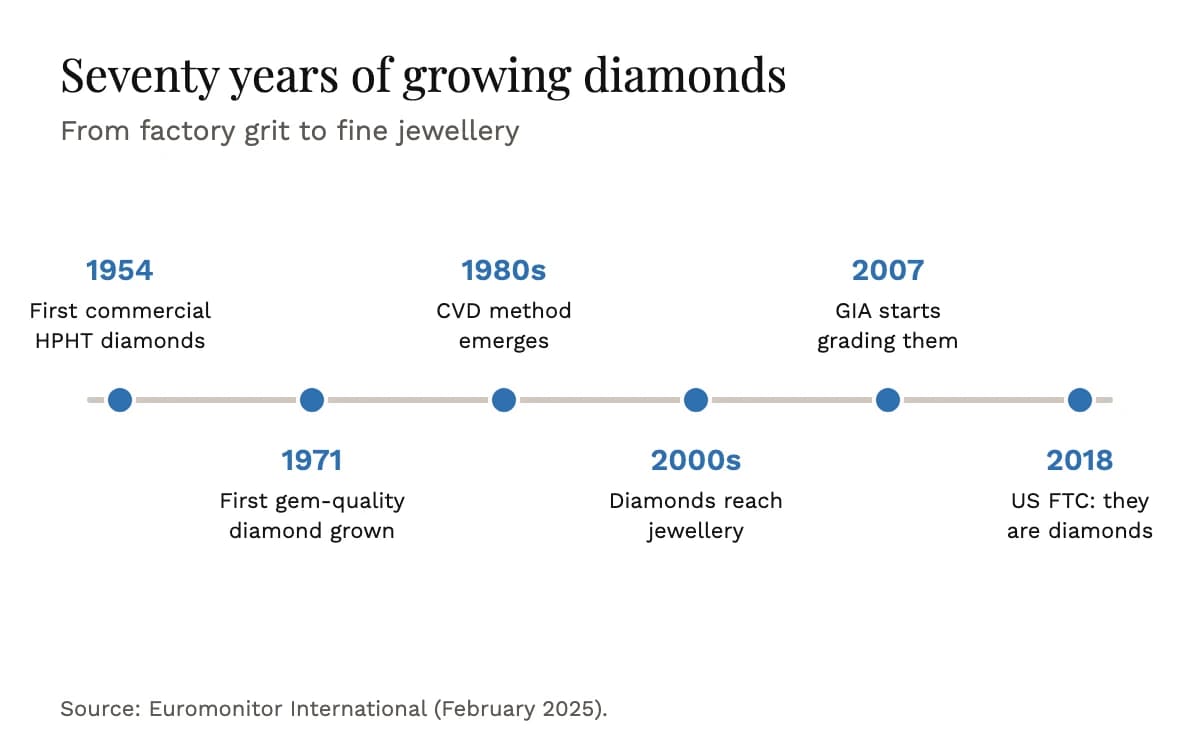
Earlier than most people think. Euromonitor International's February 2025 report traces the story like this:
- 1954: General Electric makes the first commercially viable laboratory-grown diamonds, using HPHT, for industry.
- 1971: the first gem-quality laboratory-grown diamond is made.
- 1980s: CVD emerges as a way to grow high-quality diamond.
- 2000s: laboratory-grown diamonds enter fine jewellery.
- 2007: the Gemological Institute of America begins grading them.
- 2018: the US Federal Trade Commission recognises them as diamonds.
Here is a surprising fact: most laboratory-grown diamond is not jewellery at all. The US Geological Survey estimated world production of synthetic industrial diamond at about 15.4 billion carats in 2022, according to Statista, mostly as grit and powder for cutting, drilling and polishing tools. Gem-quality diamonds are a small, carefully grown part of that.
How long does it take to make a finished piece?
A gem-sized CVD diamond grows in a few weeks. Then the craftsmanship begins: the rough crystal is planned, cut and polished, exactly as a mined diamond would be. After cutting, the stone goes to an independent laboratory such as IGI or SGL to be graded, and then it is set.
For a Maanorah piece, the making starts when you order. Crafting takes 7 to 10 days, certification and hallmarking 2 to 3 days, and free insured delivery 3 to 5 days.
Can you tell a CVD diamond from an HPHT diamond?
Not by eye. Once cut and polished, a CVD diamond and an HPHT diamond of the same grade look identical, even under a jeweller's loupe. Telling them apart takes laboratory equipment that reads how the crystal grew. The same equipment is how grading laboratories confirm that a diamond is laboratory-grown at all, which is why the certificate matters.
What is post-growth treatment?
Some laboratory-grown diamonds, especially CVD stones, are gently heat-treated after growing to improve their colour. It is a standard, permanent process and does not affect the diamond's durability. A grading report from a laboratory such as IGI usually records the growth method and any post-growth treatment in its comments. Our certificate guide shows you where to look.
So does CVD or HPHT make a better diamond?
Neither, on its own. What decides how a diamond looks is its cut, colour and clarity, and those are on the certificate. A well-cut, colourless VS diamond looks the same however it grew. When you compare stones, compare the grades. Our diamonds are hand-selected in the D to F colour range with VVS to VS clarity, and every piece is certified by IGI or SGL.
Frequently asked questions
Is a CVD diamond a diamond?
Yes. It is pure crystallised carbon with the same structure and properties as a mined diamond. It is called laboratory-grown because of where it formed, not because it is any less a diamond.
Which is more common in jewellery, CVD or HPHT?
CVD is now the leading method for gem diamonds, though HPHT is still used, often for smaller stones. Both are graded on the same 4Cs scale.
Will a CVD diamond change colour over time?
No. A finished diamond, CVD or HPHT, keeps its colour for life.
Is a laboratory-grown diamond the same as moissanite or cubic zirconia?
No. Moissanite and cubic zirconia are different materials that only look similar. A laboratory-grown diamond is diamond. Our comparison with mined diamonds and our diamond education page go deeper.
You can see CVD laboratory-grown diamonds set in our rings and earrings.
About Maanorah: we are a family jeweller based in Bengaluru, with more than 60 years and three generations in the trade. Every piece we make uses IGI or SGL certified laboratory-grown diamonds in BIS-hallmarked gold, with a full price breakup, a 7-day return and a lifetime exchange. If you have a question about anything here, message us on WhatsApp. We are happy to help, whether or not you buy from us.