
Diamonds, Every Day: How India Wears Jewellery Now
Maanorah Team
Our family has worked in jewellery for more than 60 years, across three generations. In that time we have watched Indian jewellery change many times. The last few years have brought some of the biggest changes yet, and the latest market research puts numbers to what we see every day.
Here are six of them, and what each one means when you are choosing jewellery.
How big is India's jewellery market?
About US$94 billion in 2025, roughly a quarter of all jewellery sold in the world. Grand View Research's 2026 jewellery market analysis places India roughly level with China, forecasts about US$153.8 billion by 2033, and expects India to grow a little faster than the world as a whole.
1. Diamonds are a small part of Indian jewellery, and growing
Most Indian jewellery is still gold. Euromonitor International estimates that diamonds made up about 13% of India's fine jewellery sales in 2024, against about 44% in North America. Bridal jewellery alone is roughly half of India's gold jewellery demand by weight, according to World Gold Council and Metals Focus figures cited by Grand View Research.
Euromonitor sees diamond jewellery growing in India as incomes rise and diamonds become more affordable. For many families, the diamond piece being bought today is their first.
What we tell first-time buyers: start with something you will wear often, rather than a single large stone.
2. Laboratory-grown diamonds have found a home in India
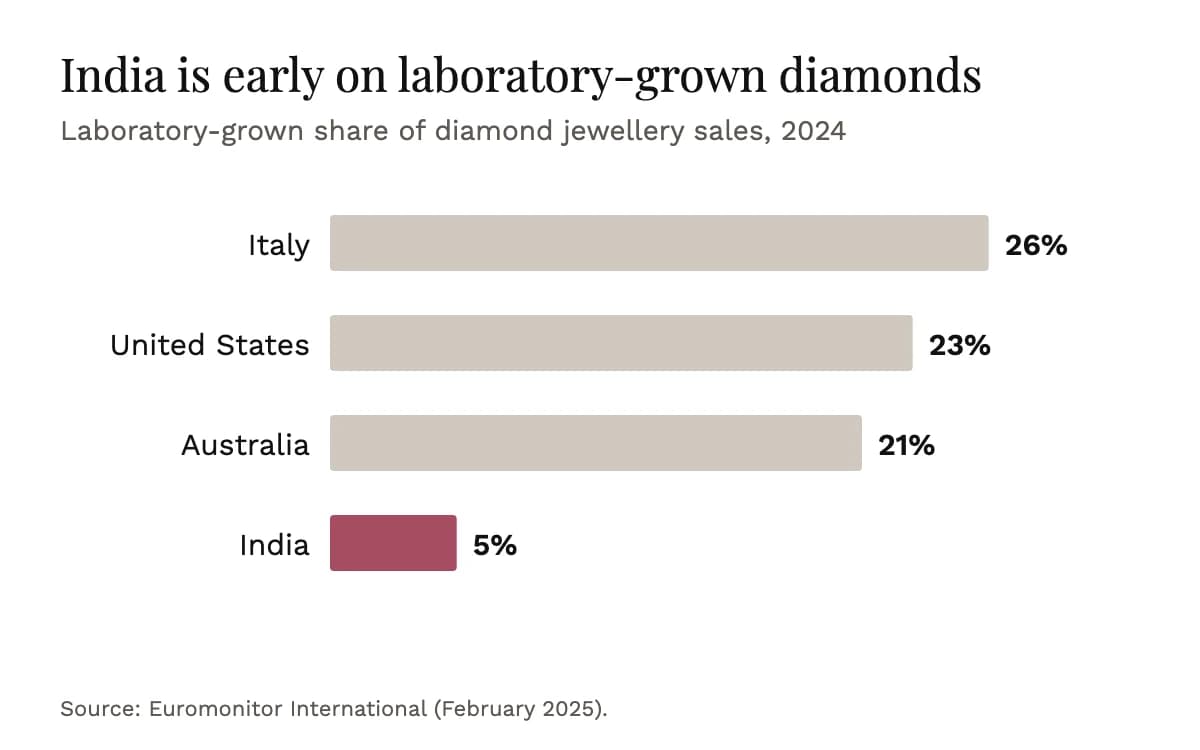
Euromonitor estimates India's laboratory-grown diamond jewellery sales at about US$452 million in 2024, the third largest of the ten markets it tracked, after the United States and Canada. They were still only about 5% of India's diamond jewellery sales, so the story here is just beginning.
India also makes a great many of these diamonds. Grand View Research, citing GJEPC export data, reports polished laboratory-grown diamond exports up about 27.6% year on year in July 2025. Our comparison of laboratory-grown and mined diamonds explains how the two compare.
3. Jewellery is becoming something you wear every day
Grand View Research describes Indian buyers as getting younger and more urban, and choosing lightweight, diamond-set pieces and minimal designs they can wear every day. Its karat data tells the same story: bridal jewellery is still bought mostly in 22K and 18K, while fashion and everyday pieces lean towards 18K and 14K.
This is the change we feel most. People now ask us for a pair of studs to wear to work, a slim band for every day, a pendant that goes with jeans and with a saree. Our guide to 9K, 14K and 18K explains which gold suits daily wear.
4. People research online before they buy
Most jewellery worldwide is still bought in person, about 84% by Grand View Research's estimate, because people like to see valuable pieces before they pay. But online is the fastest-growing way to buy, and in India the report estimates that 50% to 60% of purchases of rings, necklaces and bracelets are influenced by what people find online.
That puts more weight on the things you can check from a screen: an independent certificate, a BIS hallmark, a clear price breakup and written return terms. We think every jeweller should make those easy to find. Our certificate guide shows how to check them.
5. Gold prices are shaping what people choose
The average gold price rose from about US$1,954 an ounce in 2023 to about US$3,473 in 2025, according to figures in Grand View Research's analysis. India bought about 5% more gold by weight in 2024 and paid about 31% more for it.
So people are choosing more thoughtfully. Lighter designs and 14K or 9K gold keep everyday pieces within reach, while the high-karat budget goes to the pieces that carry family meaning.
6. More people are buying for themselves
Jewellery used to be mostly gifted. Now many people mark their own milestones. A 2023 YouGov survey cited by Grand View Research found that 35% of Indians surveyed planned to buy luxury jewellery within the next twelve months, against about 6% in the United States. India also leads the world in new online laboratory-grown diamond jewellery brands, with 65 of the 166 tracked by Tracxn in November 2026, which means more choice for buyers than ever before. Our guide to buying your first diamond for yourself is written for exactly this moment.
What does it all add up to?
Indian jewellery now has two sides that sit happily together. Wedding and heirloom pieces are still mostly high-karat gold, bought as much for their value as for their looks. Everyday jewellery is becoming its own thing: lighter, design-led, often set with laboratory-grown diamonds, and chosen as carefully as anything else we own.
Whether a piece is for every day or for an occasion, we make it the same way: IGI or SGL certified laboratory-grown diamonds, BIS-hallmarked 9K, 14K or 18K gold, made to order and delivered free across India.
Frequently asked questions
Is laboratory-grown diamond jewellery popular in India?
It is growing quickly. Euromonitor estimates India's laboratory-grown diamond jewellery sales at about US$452 million in 2024, the third largest of the markets it tracked.
Why is gold still the main jewellery purchase in India?
Because gold carries cultural and family meaning. It is bought for weddings and festivals and is widely seen as savings. Grand View Research names the view of gold jewellery as an investment as the main driver of India's market.
How can I shop for diamond jewellery online with confidence?
Look for an independent IGI or SGL certificate, a BIS hallmark with HUID, a written price breakup and a clear return policy. A good jeweller will show you all four without being asked.
About Maanorah: we are a family jeweller based in Bengaluru, with more than 60 years and three generations in the trade. Every piece we make uses IGI or SGL certified laboratory-grown diamonds in BIS-hallmarked gold, with a full price breakup, a 7-day return and a lifetime exchange. If you have a question about anything here, message us on WhatsApp. We are happy to help, whether or not you buy from us.